The workbench for guiding consequential decisions.
Structured fact finding, context-aware analysis, and client-ready deliverables in a single workspace for each engagement. Built around how you actually work, backed by your methodology and connected by context.
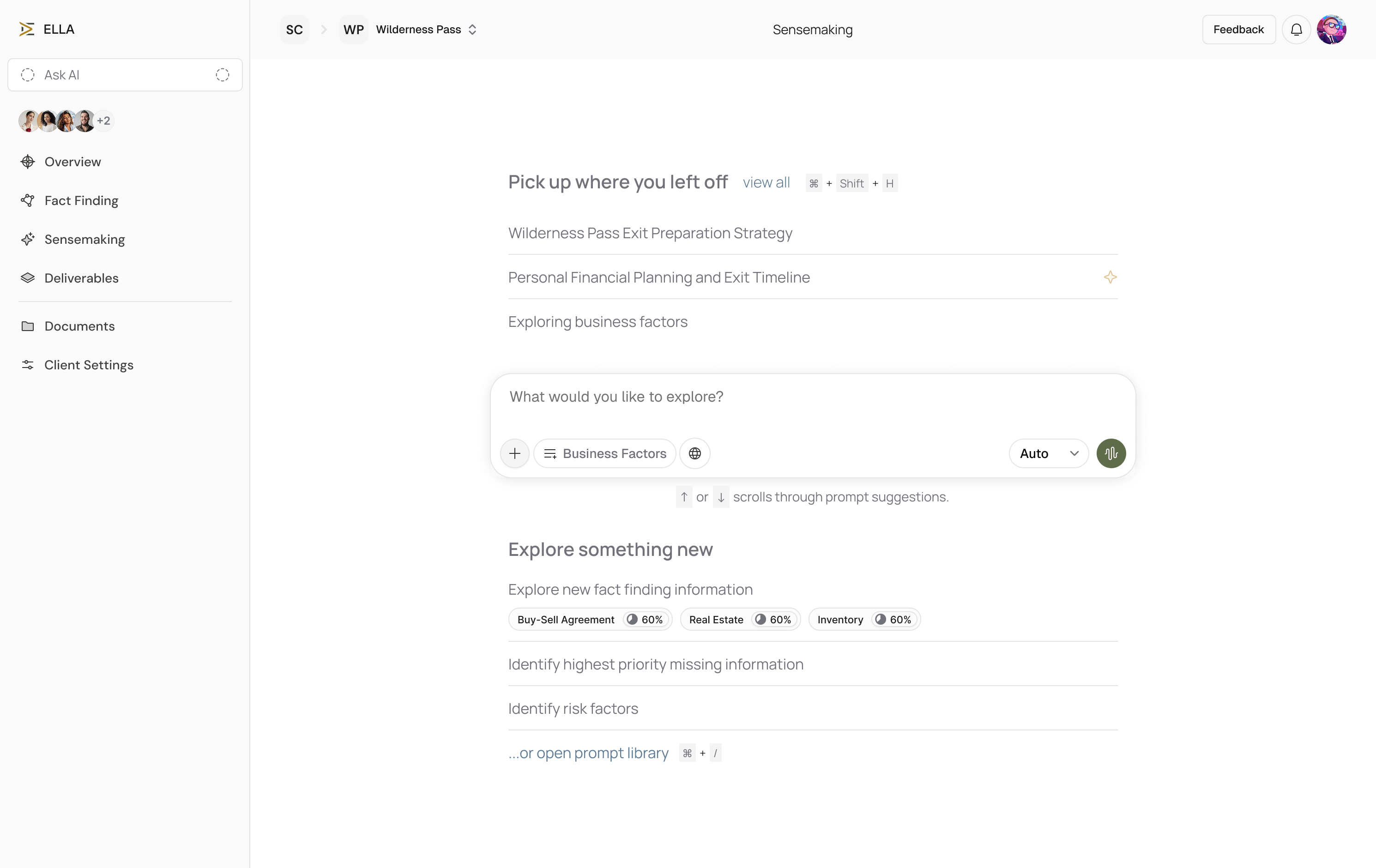
Meet the ELLA Platform
Built around the advisor's methodology, with tools that match how you actually work with clients.
Fact Finding
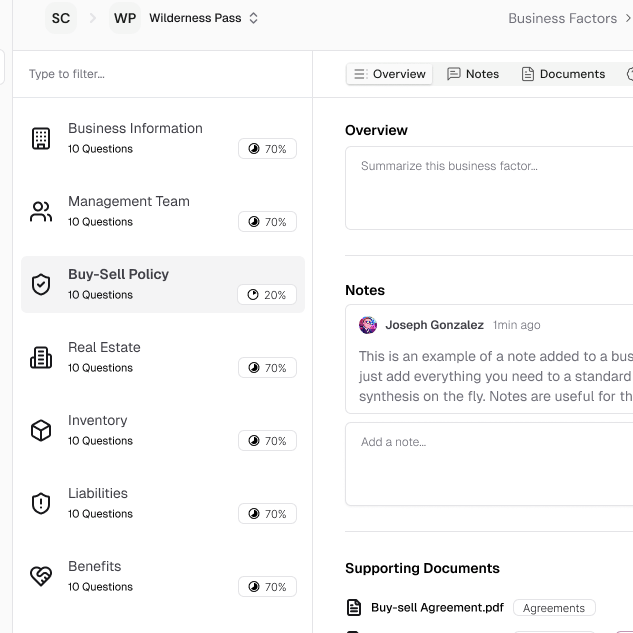
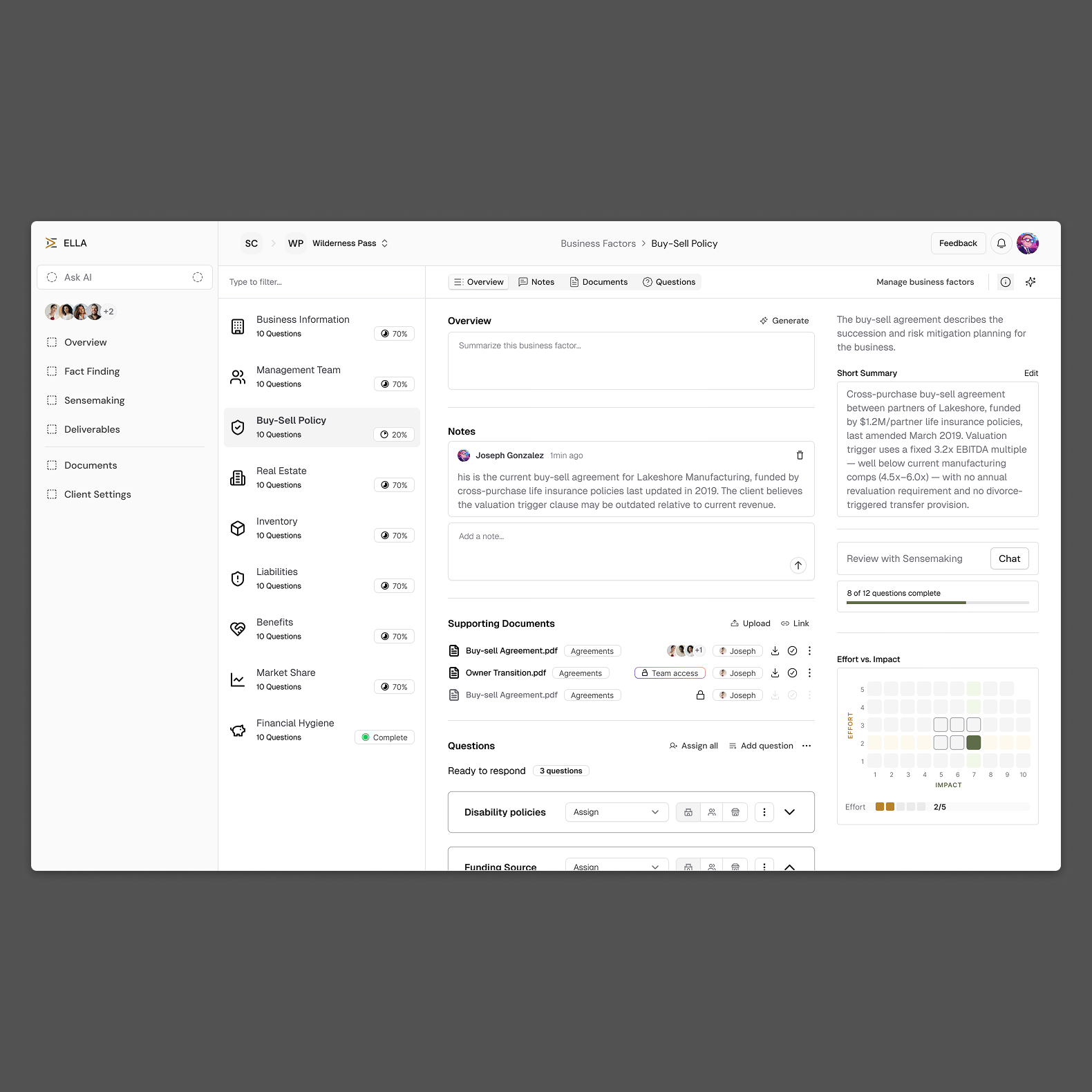
Your discovery process is one of the most valuable things you've built. ELLA's Fact Finder gives it structure that holds as your practice scales — without stripping away the flexibility that makes it yours. Templates, notes, documents, and questions all in one connected space.
Sensemaking
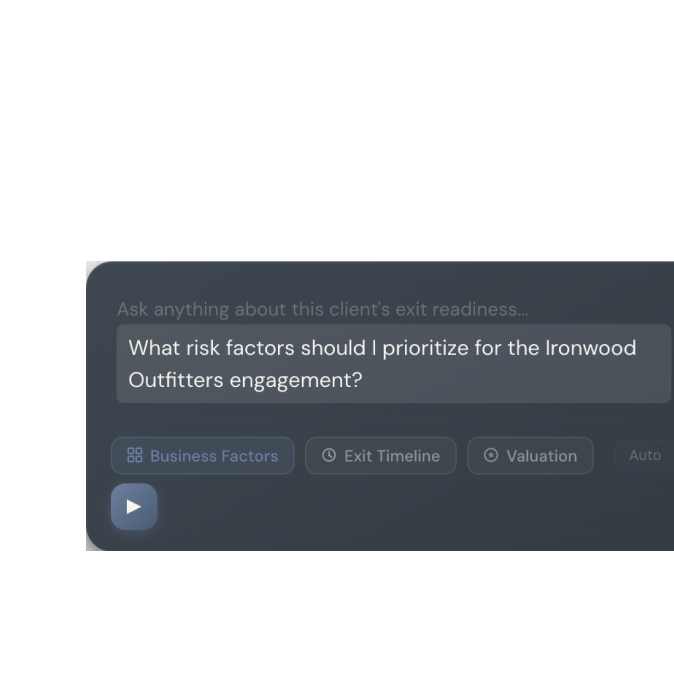
Most AI gives you a chatbot and calls it analysis. Sensemaking assembles context from your entire workspace and applies domain-specific analytical skills built for how advisors actually evaluate a business. The more you use it, the more it adapts to how you think.
Deliverables
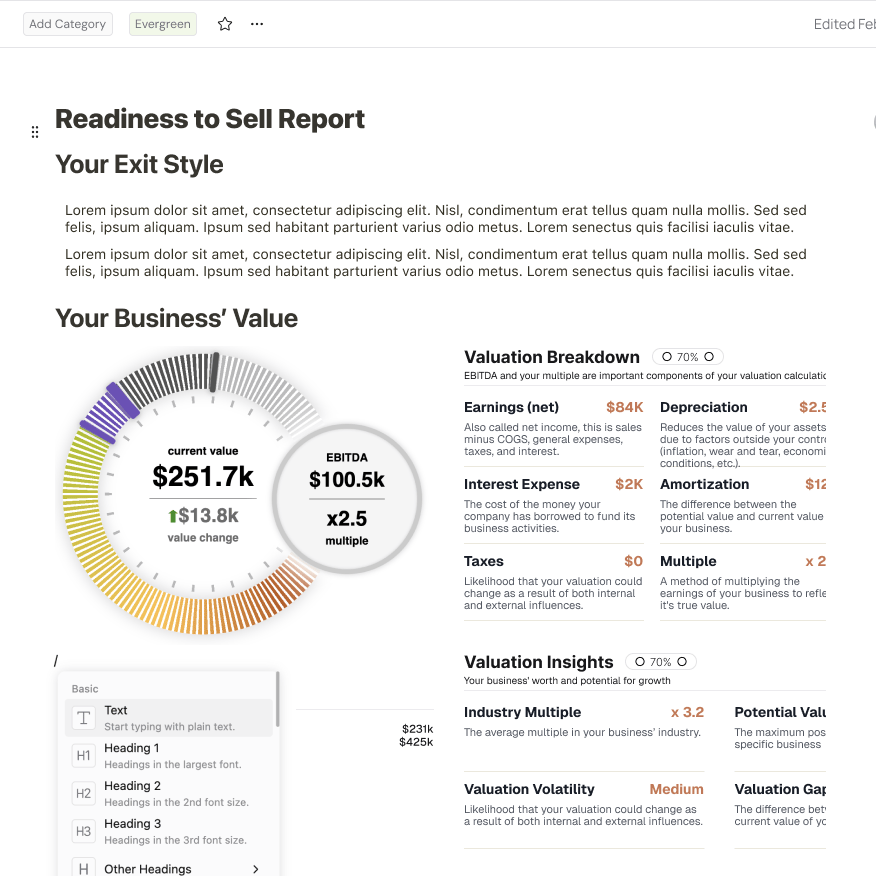
Every document should reflect the specific client, the specific engagement, and the advisor's actual thinking. We built a block-based editor that's connected to your workspace data but works like a doc. Start from a template, pull in sensemaking insights, and invite collaborators to review.

Collaboration
Exit planning is a team effort, and the whole team needs a place to work. The collaborator interface gives CPAs, attorneys, wealth managers, and business owners a scoped view of exactly what they need to see, contribute to, and review. No clutter, no learning curve.
Fact Finding
Structured discovery built around your priorities.
What makes you unique? We think part of it is your methodology: the questions you ask, the order you ask them, the way you read between the lines of a balance sheet and a conversation. We built fact finding so it holds that structure without flattening it into someone else's process.
Start with research-calibrated templates across M&A readiness, succession planning, personal readiness, and vertical-specific domains. Or build your own from scratch. Group business factors by the categories that match how you think, add questions, reorder them, and layer in notes that link directly to each discovery item. As documents come in, the system cross-references uploaded files against your open questions and surfaces suggested answers for your review.
Every answer, every note, and every document becomes context that carries forward into Sensemaking and Deliverables. Nothing gets lost between intake and analysis.
Modular templates built around your methodology
Start with production-ready templates across advisory domains, or build your own from scratch. Group business factors, customize question types, and structure discovery the way you think about it.
Linked notes and supporting documents
Notes attach directly to discovery questions. Documents cross-reference against open questions so every piece of evidence connects to the question it answers.
Document ingestion and extraction
Upload financials, legal documents, or operational records. The system reads them, identifies relevant answers to your open questions, and surfaces suggestions you review and approve.
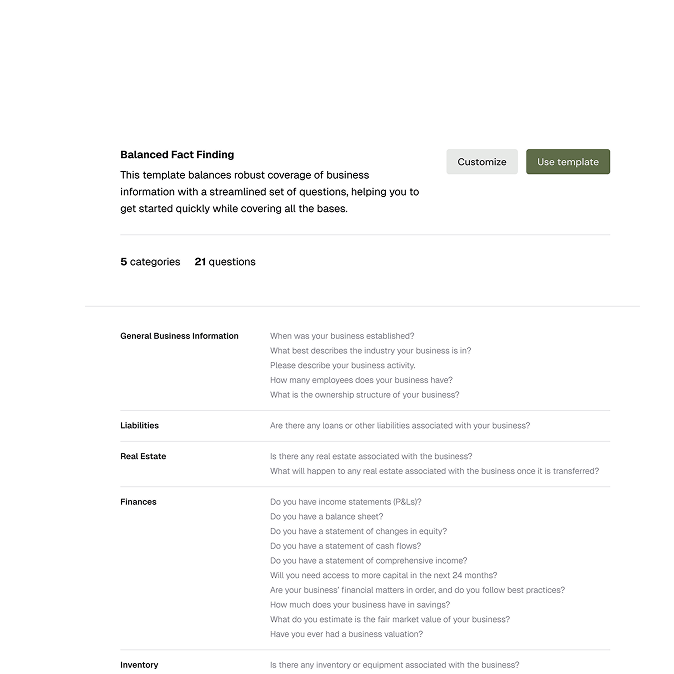
Modular Templates
Start with research-calibrated templates or build your own. Group business factors your way, customize question types, and add as many as you need.

Linked Notes & Documents
Notes attach directly to discovery questions. Supporting documents are cross-referenced so every piece of evidence connects to the question it answers.
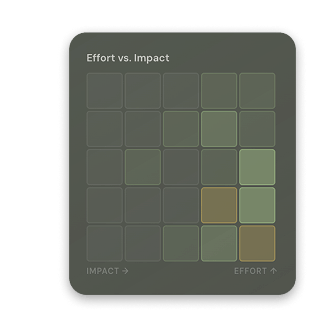
Impact Gap
Track completion across business factors and see where the gaps are. Understand the current state of the company at a glance and know where to focus next.
SENSEMAKING
Insight grounded in context.
When you open a sensemaking session, the system already knows your client. It assembles context from everything in the workspace: fact finding answers, uploaded documents, prior conversations, and the specific business factors you scope in. We call this prompt composition. Rather than dumping everything into a single context window, the system selects, structures, and layers relevant data alongside domain-specific analytical skills: financial hygiene, owner readiness, risk breakdown, document analysis, valuation prep. These are structured frameworks calibrated to how advisors evaluate a business, not generic prompts dressed up with a label.
This is what separates purpose-built sensemaking from dropping files into a Claude project or a ChatGPT thread. A general-purpose AI doesn't know what a normalized EBITDA add-back is, doesn't understand why owner dependency is a value driver, and can't tell a succession plan that's been operationalized from one that exists only on paper. We built that domain intelligence into the system so you don't have to prompt-engineer your way to useful output every time you sit down.
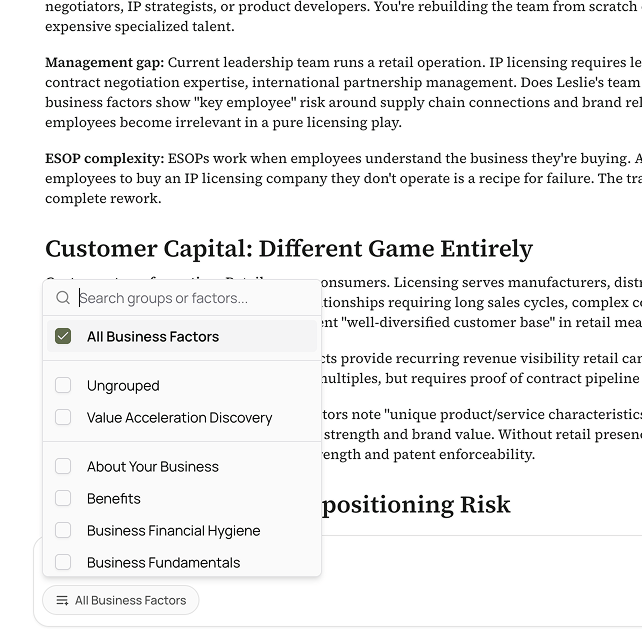
Context-Aware Analysis
Every session draws from the full workspace. Select specific business factor groups or analyze everything at once. The system knows what you've collected and structures it before the model ever sees it.
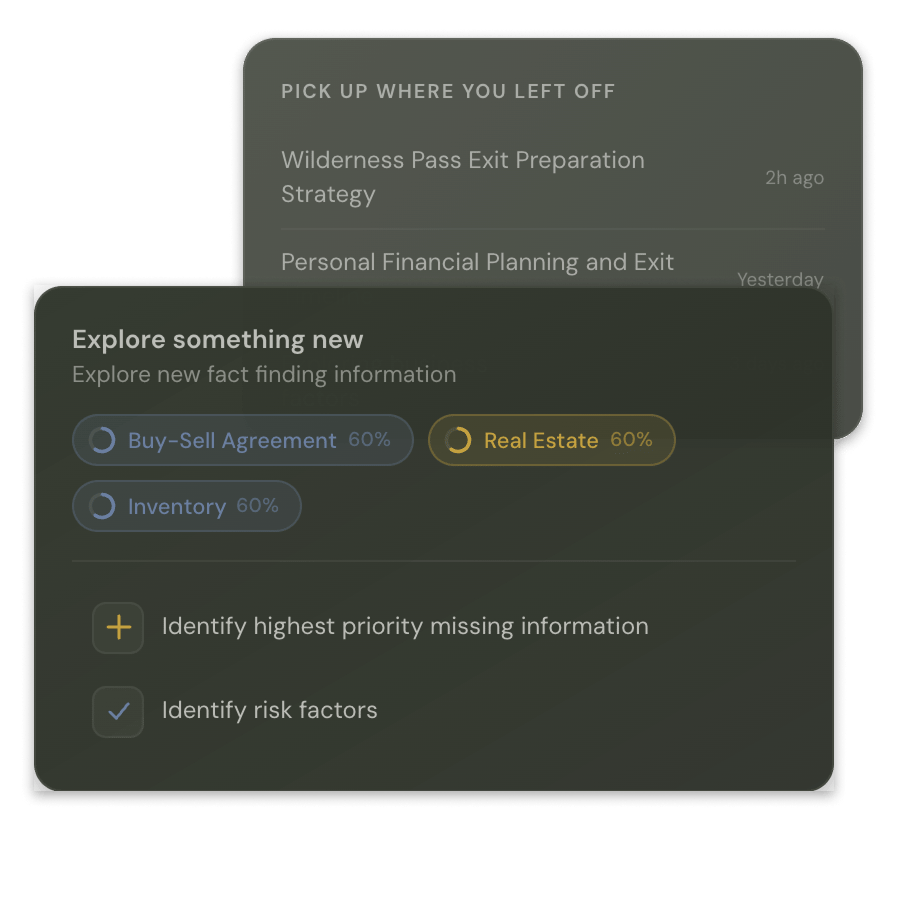
Domain-Specific Analytical Skills
Financial hygiene, owner readiness, risk breakdown, document analysis, and valuation prep. These run based on what you ask, calibrated to how advisors evaluate a business.
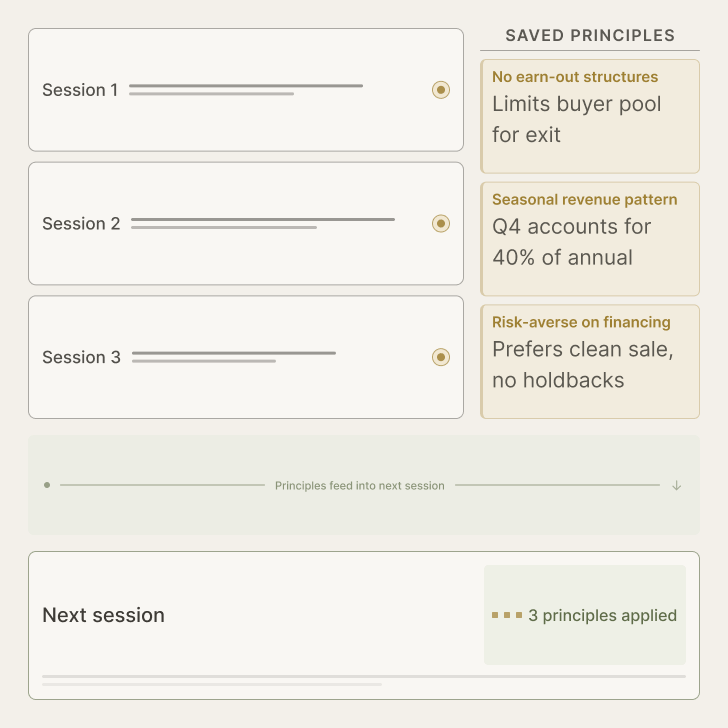
Memory
When you correct the AI, those corrections persist. The system remembers details about each engagement and adapts to your judgment over time, so you stop repeating yourself across sessions.
Anatomy of a prompt
Adding context with every input
A fully-enriched sensemaking response
Fact Finding
Management team assessment and key-person dependency, answered during discovery.
Engagement Memory
Advisor correction: owner prefers no earn-out structures.
Prior Session
Valuation prep flagged the outdated buy-sell clause two weeks prior.
What are the biggest risks to this exit timeline?
Owner dependency is the primary risk factor.
Turner holds all key client relationships and sole vendor signatory authority. No documented succession for operations.
Revenue concentration creates buyer risk.
Three clients at 62% of trailing revenue. Stress-scenario EBITDA impact: -$160K.
Exit timeline is constrained by buyer pool.
18-month target assumes broad buyer access, but no-earn-out preference narrows viable acquirers.
Wealth gap is manageable but timeline-sensitive.
$1.2M desired vs. $160K gap at current FMV. Achievable in 24 months; compressed timeline raises execution risk.
Buy-sell agreement requires immediate attention.
Life-insurance funded, unreviewed for three years. Valuation methodology clause outdated.
Uploaded Documents
Three years of financial statements, analyzed via Financial Hygiene.
Cross-Referenced Analysis
Owner Readiness calculated the wealth gap. Risk Breakdown linked it to timeline.
One question. Five ingredients. Six months of structured engagement data.
Sensemaking

Built to make sense of the work that happens beyond the desk
DELIVERABLES
From analysis to understanding.
The last thing an advisor needs is another tool that produces generic 90-page reports nobody reads. Deliverables live inside the same workspace as your fact finding and sensemaking, so every document is grounded in real data from the engagement, not copy-pasted from a chat window.
Pull insights directly from a sensemaking conversation into a document. Use the block-based editor to compose, rearrange, and refine, and invite collaborators to review and comment in real time. AI assists with drafting, but the advisor controls the final word, because these documents carry your name and your reputation.

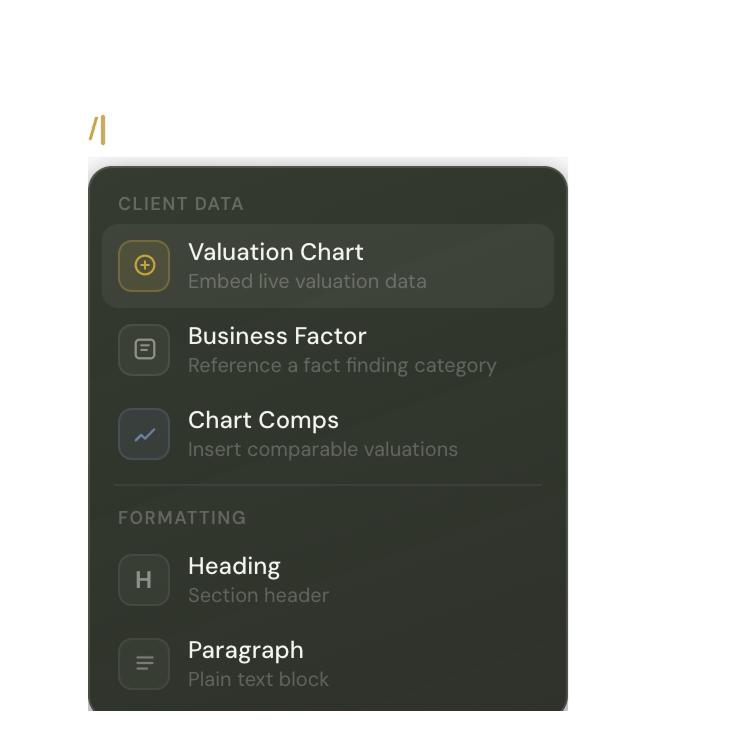
Block-Based Editor
Type / to insert blocks for formatting or referencing client data. Press space to draft with Sensemaking inline. It works like a doc you already know, connected to the data you've already collected.
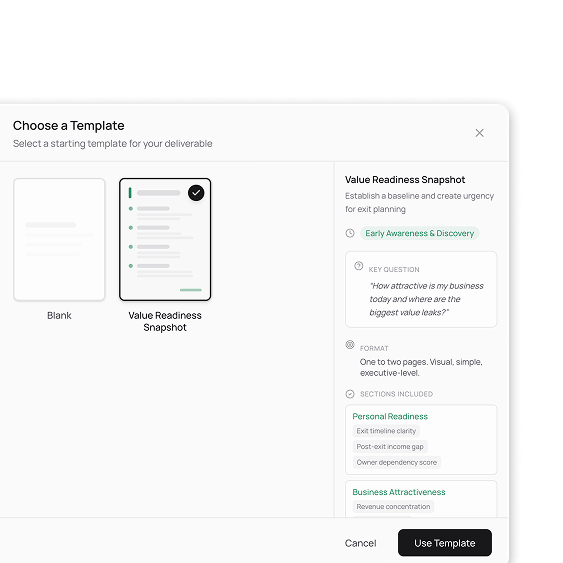
Templates
Start from deliverable templates that match your practice: exit readiness scorecards, preliminary financial audits, value acceleration plans. Customize the structure and reuse across engagements.
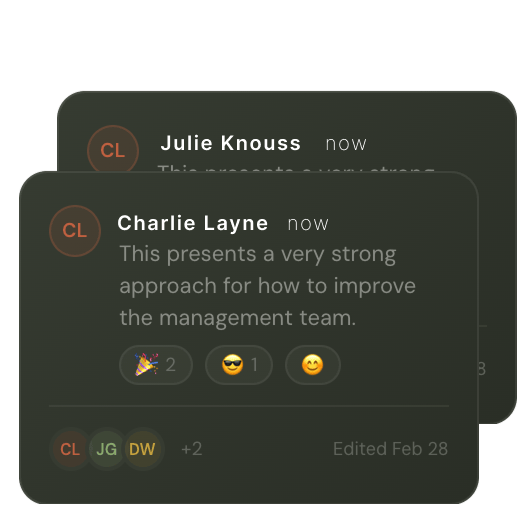
Multiplayer & Comments
Invite collaborators to review deliverables and leave comments directly in the document. Threaded conversations keep feedback organized and connected to the specific content it references.
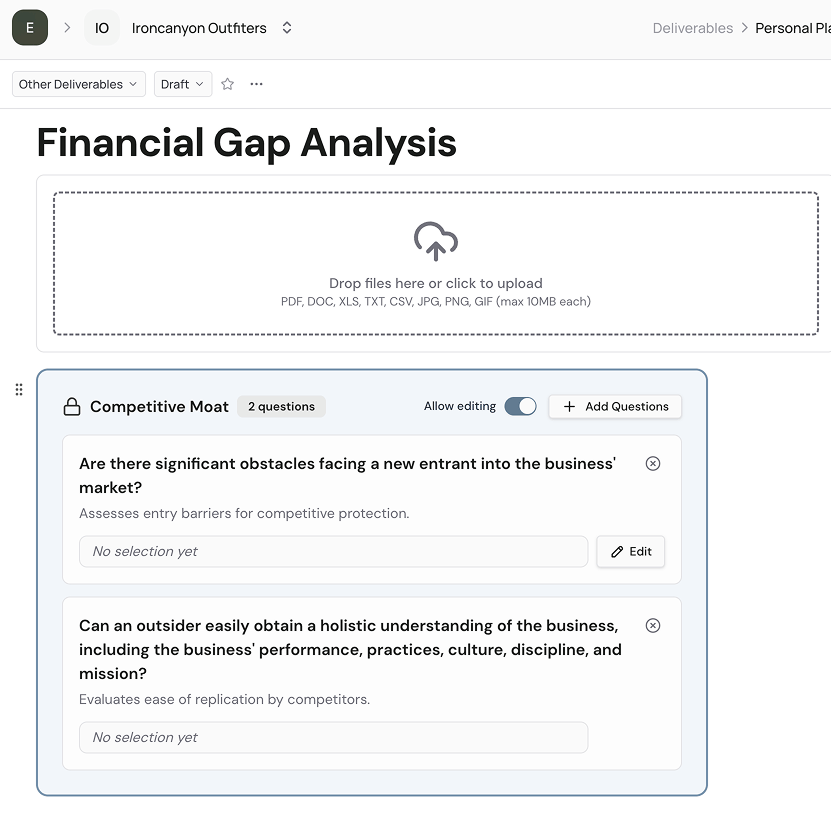
Connected to Context
Turn a sensemaking response into a deliverable with one action. Embed upload fields that connect directly to fact finding, so clients can contribute data from inside the document itself. The data flows both ways.
Collaboration
The whole team, one workspace
The CPA running tax analysis, the attorney reviewing the buy-sell agreement, the wealth manager stress-testing retirement projections, and the business owner contributing context only they can provide. They all need to see the right information, contribute in the right places, and trust that their data stays where it belongs.
We built the collaborator interface as a purpose-built experience for everyone on the exit team who isn't the lead advisor. Collaborators see only what's been shared with them: the fact finding questions assigned to them, the published deliverables relevant to their role, and the documents that require their input. No sidebar clutter. No billing screens. No features they don't need.
For business owners, this is where they contribute financial data during fact finding, review deliverables as the engagement progresses, and comment on documents that directly affect their business. How they experience the platform reflects directly on the advisor who invited them.

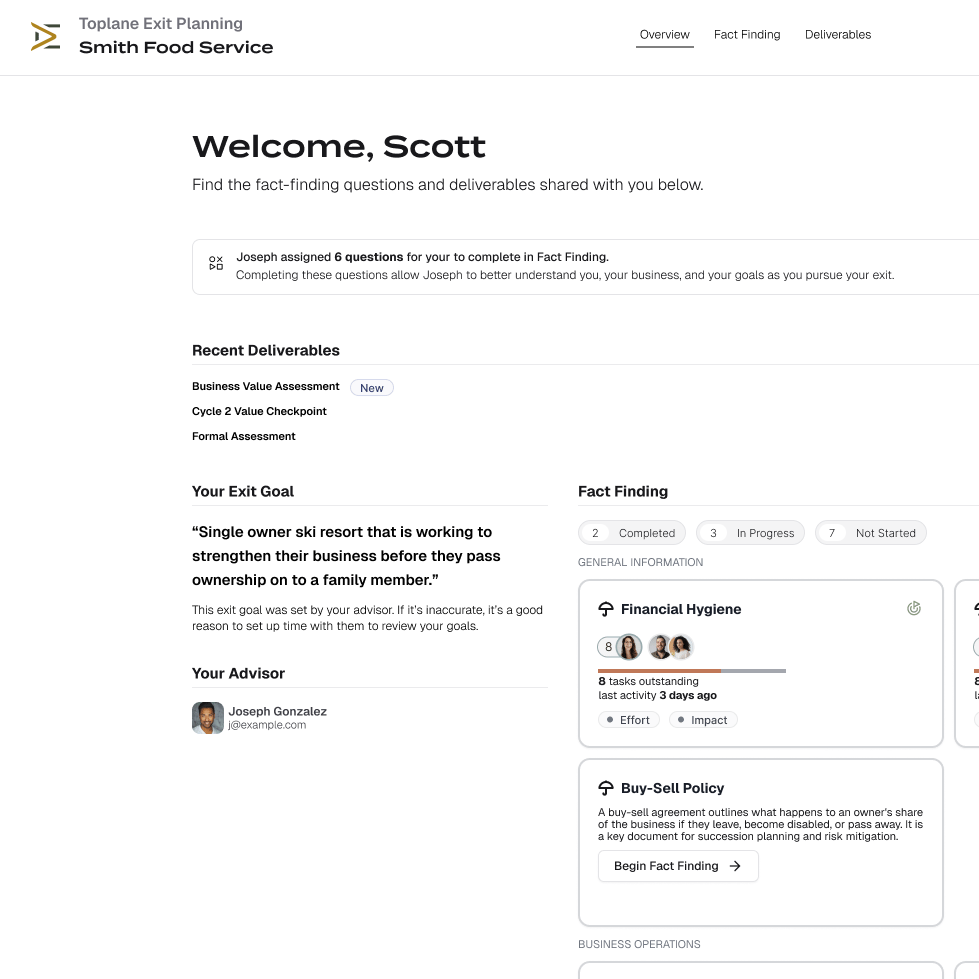
Role-Scoped Access
Collaborators see only what's shared with them. Fact finding questions, published deliverables, and relevant documents, scoped by workspace role. No access to advisor-only features like sensemaking or billing.
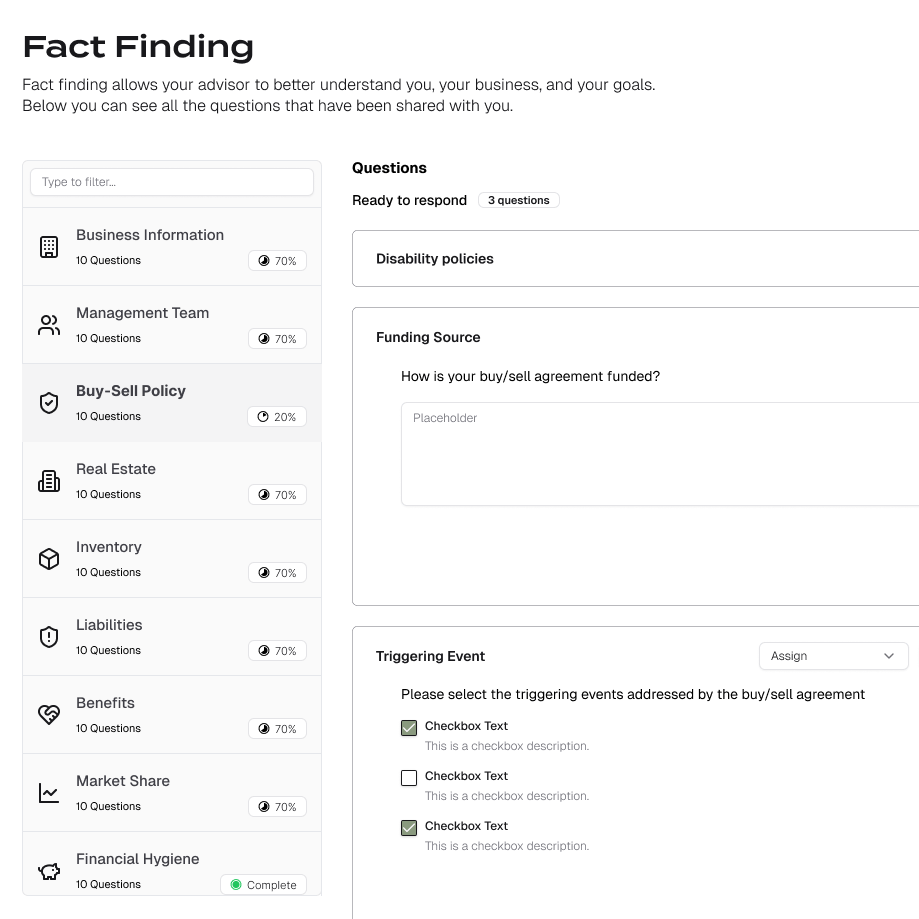
Direct Data Contribution
Business owners and team members answer fact finding questions directly in the platform. Their answers flow into the same structured data the advisor uses for sensemaking and deliverables.
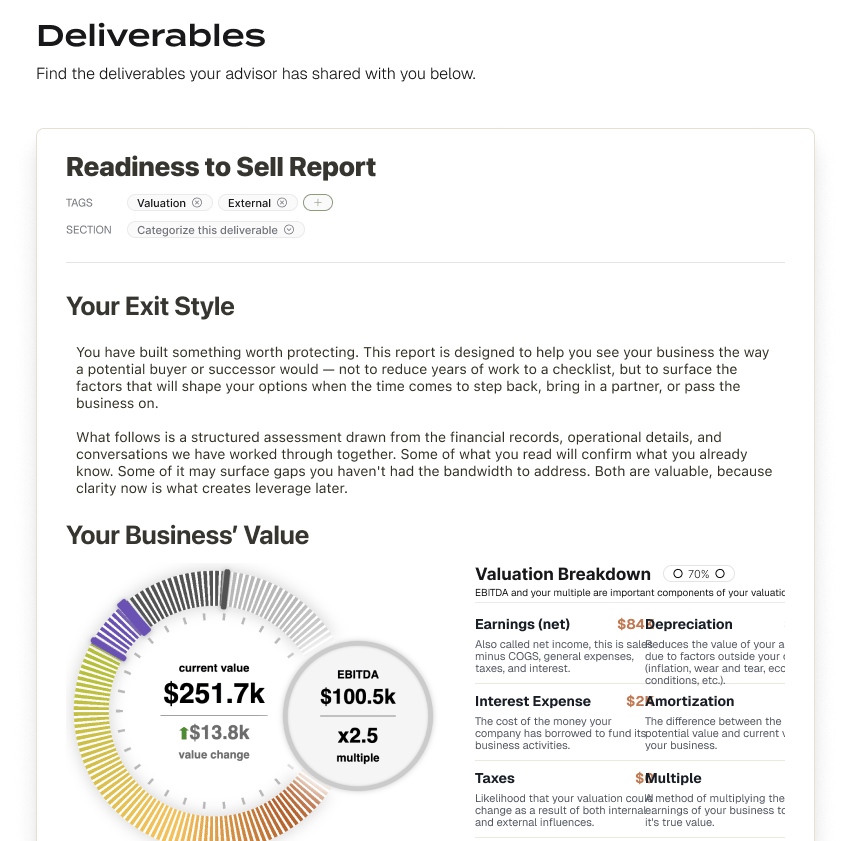
Deliverable Review & Comments
Collaborators review published deliverables and leave comments directly in the document. Threaded conversations keep feedback organized and connected to the content it references.